Information for the teacher to become familiar with before teaching the first 5 weeks of class: The 5 Levels of Consciousness.
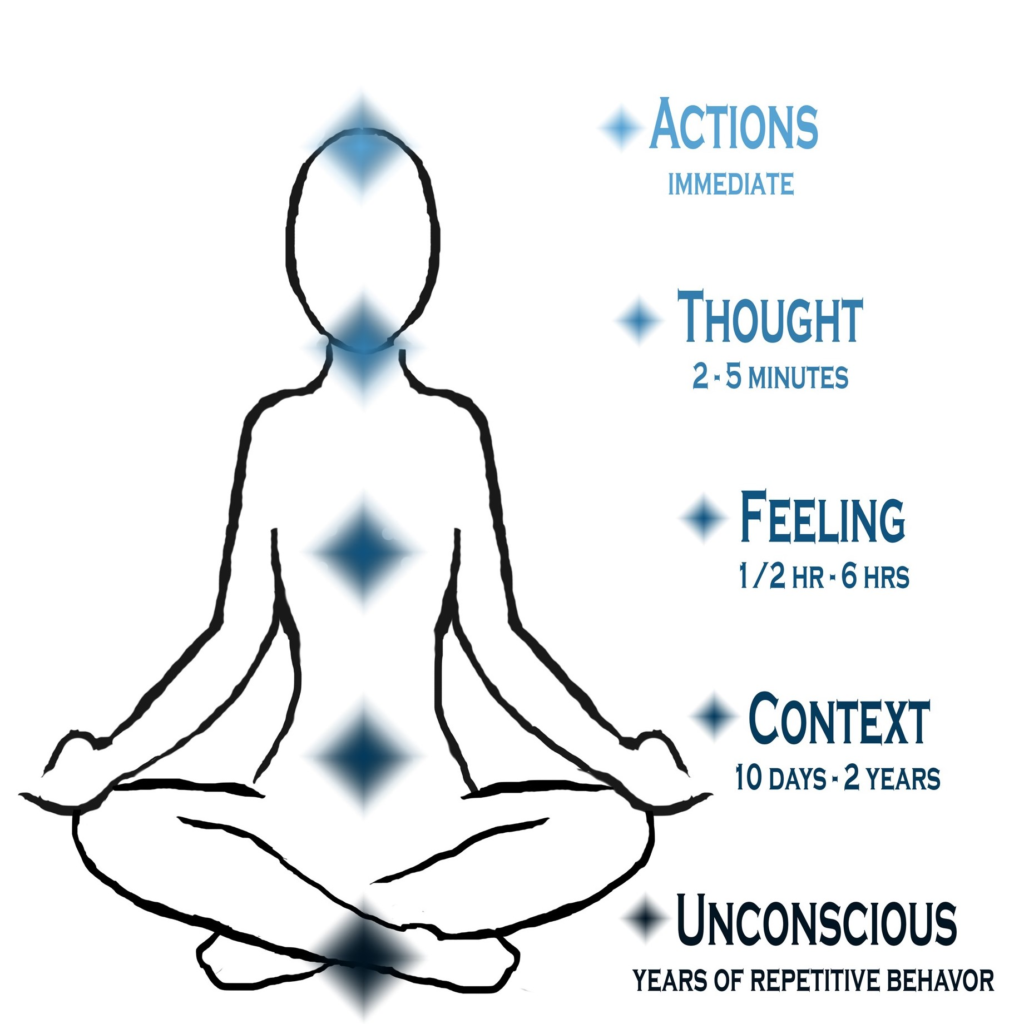
We divide consciousness into 5 levels based on how much awareness and how much control we have over that part of ourselves. As you go deeper through the levels, you are generally less aware of how the level is affecting you, and the less immediate and direct control you have over these levels.
The 5 Levels of Consciousness are as follows:
-
- Actions
- Thoughts
- Feelings
- Context
- Unconscious
Actions
Actions are everything we consciously do or say. These are things we are aware of, actions we choose to take, and words we choose to speak. This is the most visible level of consciousness, completely on the surface. When we are acting, anyone who is around us can watch and draw conclusions. This means Level 1 is a completely shared level.
Also, although it may not always feel like it, Level 1 is completely under our control. Because this level is made up only of actions, we are conscious of, we must consciously choose each word we say and every action we take.
Thoughts
Thoughts are the first internal, invisible level of consciousness. Our thoughts occur inside of us, and no one can hear your thoughts or read your mind, no matter how much we wish our spouses, partners, or children could. We are generally aware of our thoughts, at least if we turn our attention to them. We can convert our thoughts into words, although imperfectly, to share them with others, so thoughts are a somewhat shared level of consciousness. We share thoughts using actions, both words and deeds. We say, therefore, that Level 2 is shared through Level 1.
Our thoughts are not as much under our control as our actions. Thoughts occur to us all the time, introduced by other people, media, or just randomly it seems. While we may choose to think specific things, not every thought is a choice we make. Therefore, Level 2 is not completely under our control.
Feelings
Feelings are the second internal, invisible level of consciousness. Like our thoughts, our feelings occur inside of us. We are sometimes aware of our feelings and other times we are almost completely unaware of them. Also, like our thoughts, we can sometimes convert our feelings into words, although imperfectly, to share them with others. We do, however, sometimes have feelings that we have no words for and therefore are unable to express or even acknowledge. So, feelings are an even less shared level of consciousness than our thoughts though still shared to a small degree. We share feelings using actions, both words and deeds. We say, therefore, that Level 3 is shared when we have sufficient vocabulary through Level 1.
Our feelings are not under our control as our actions or even our thoughts are to some degree. We are constantly experiencing feelings, either as a sensation or as an emotion. These feelings result from influences from other people, media, other levels of consciousness, or just randomly it seems. While we may choose to do, say, or think about specific things, we do not choose our immediate feelings. Therefore, Level 3 is not under our control.
Context
Context is the third internal, invisible level of consciousness. We are generally unaware of our contexts, unless we turn our attention to them and even then, we sometimes cannot understand or become aware of a context without outside observers helping us to see them. Once we become aware of a context, we can convert them into words, like thoughts and feelings often imperfectly, to share them with others. Sometimes others can observe our own contexts while we are unaware of them. We share contexts using actions, both words and deeds. We say, therefore, that Level 3 can be shared through Level 1 once we are made aware of it.
We cannot control our contexts which are established over time through our culture, upbringing, family, background, environment, etc. Like our feelings contexts are not under our immediate control but we can use our actions to change a context though this is very difficult and usually takes a lot of time. Contexts can only be intentionally changed through repetitive actions and after one has become aware of the context in question. Therefore, Level 4 is not under our control.
Unconscious
The unconscious is everything we do unawares. These are things we are unaware of, actions we do without thinking about it at all. After actions, unconscious is the most visible level of consciousness, mostly on the surface. Actions like walking, riding a bike, breathing and blinking are all unconscious as we do them without needing to think about them to make them happen. Level 5 is a mostly shared level where we tend to be unaware of what or how we are doing, but others are aware.
Also, although it may not always feel like it, Level 5 is completely under our control when we choose to make ourselves aware of the unconscious actions. However, when we don’t make ourselves aware, we give up control and allow our physical bodies to take control without our own awareness.
Familiarize yourself with the above material before attempting to teach it to your children. These are simple principles that make a lot of sense to us because we have been living with these levels for many years. However, young children have only been living with them for a short time. So, teaching these principles to our children should be done carefully. Some children may still be nonverbal and therefore need to be integrated into the lessons in ways that are action based (rather than asking them to tell you about things ask them to show you).
Information for the teacher to become familiar with before teaching the weeks 8 through 11 of class: The 4 Levels of Motivation.
An explanation of the 4 Levels of Motivation
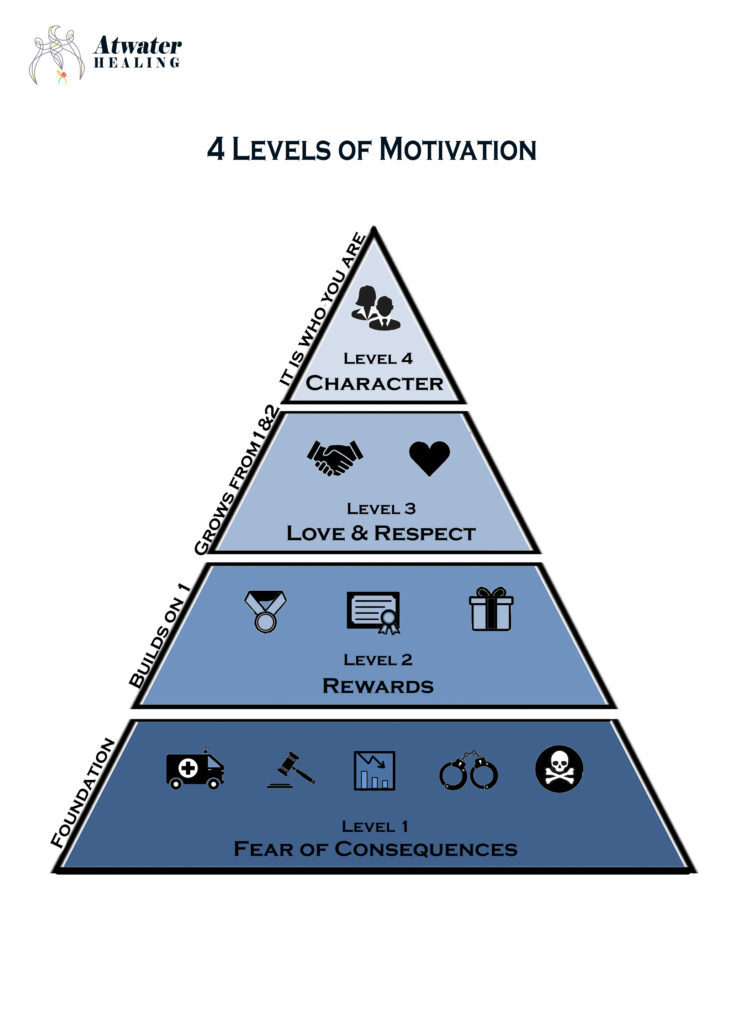
We divide motivation into 4 levels based on the reasons that we do the things we do and why we say the things we say and on the strength of the motivator. As you go deeper through the levels, you generally have stronger motivations. Thus, level one is the weakest of the levels and level four the strongest. Meaning that when faced with a decision if there are multiple motivators you are most likely to choose the action motivated by the higher of the motivators present.
The 4 Levels of Motivation are as follows:
-
- Fear of Consequences
- Desire for a reward
- Love and Respect
- Character
Fear of Consequences
When we are operating on fear of consequences, we choose to do what we do or say what we say to avoid the negative consequences of bad decisions. Or, in other words, we do the things we do and say the things we say to avoid getting into trouble.
Desire for Reward
When we are operating on a desire for a reward, we choose to do what we do or say what we say to get rewarded for good behavior and for doing what others desire us to do so they will give us what we want. Or, in other words, we do the things we do and say the things we say to get something we desire.
Love and Respect
When we are operating out of love and respect, we choose to do what we do or say what we say to make somebody we care about happy, approve of us, or not be disappointed in us. Or, in other words, we do the things we do and say the things we say to avoid disappointing others and to gain their approbation.
Character
When we are operating on character, we choose to do what we do or say what we say because we believe it is the right thing to do. We choose actions based on who we are rather than what we fear, what we want or even the approbation of others.
Proximity of time and place
Motivation is weakened by the passage of time. So, fear of consequences will be stronger than later levels if the consequence is more immediate than say the reward or love and respect. An immediate consequence may be a stronger motivator than a promised reward that will be given a week later.
Also, motivation is weakened by distance. If I am told I can earn a car by accomplishing a difficult task, but the car is a thousand miles away and there is no way for me to retrieve the vehicle then getting the title to the car is a weak motivator. Whereas, if I am told that by completing a task, I will receive a candy bar and I’m shown that candy bar and I know I can have it and eat it as soon as the task is complete that candy bar becomes a strong motivator as it is close in both time and proximity.
Motivation Builds from level to level.
Motivations build on each other. In other words when you move from one level to the next you keep the lower levels as secondary motivators. For example: if you are operating on level two trying to get a reward then you can’t avoid level one as not getting the reward would be a consequence you are trying to avoid. If you are operating on level three, out of love and respect, you are also hoping for a reward such as approbation and trying to avoid the consequence of disappointing the person you love or respect. So, level one is the only level that operates by itself. All other levels include an element of the previous levels as secondary motivators.
Information for the teacher to become familiar with before teaching the weeks 12 and 13 of class: The 6 Spheres of Influence.
An Explanation of the 6 Spheres of Influence
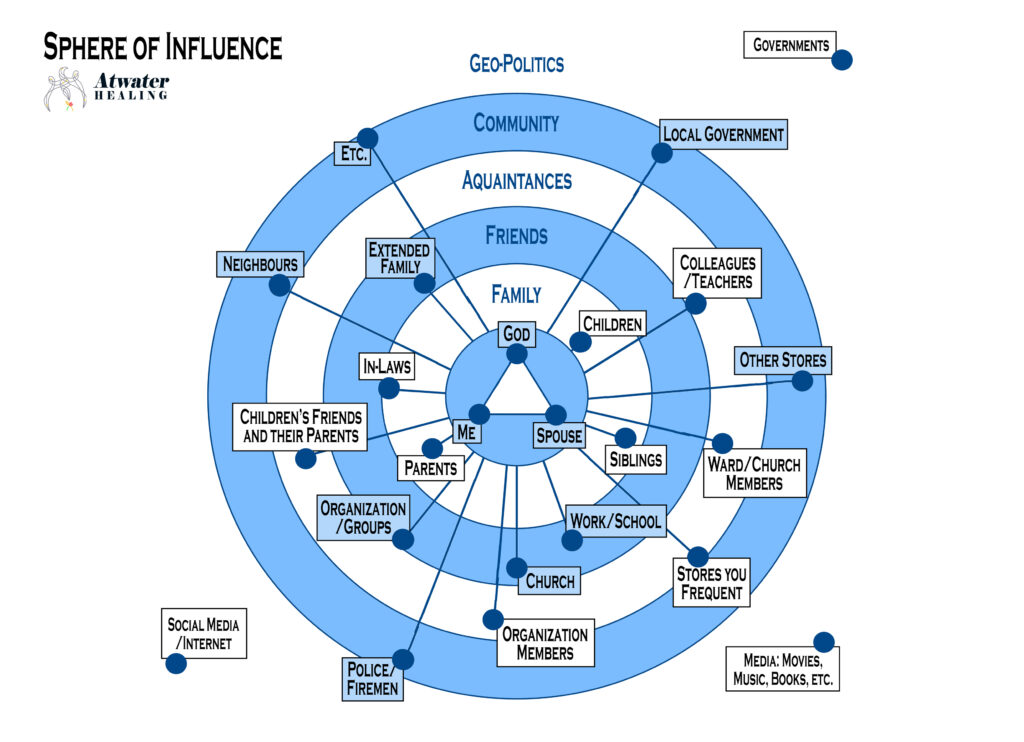
We divide influence into 6 spheres based on how much influence an individual in your life should have over your levels of consciousness. Starting from the center, people in your life should have the greatest influence and the amount of influence should lesson as you move outward to the periphery spheres. The influence in your life can be positive or negative and the 6 Spheres of Influence does not take this into account in its most basic form. What we will present to you here is an ideal structure of influences in your life. We recognize that most people’s lives do not match up perfectly with the ideal.
The 6 Spheres of Influence are as follows:
-
- Focus
- Family
- Friends
- Acquaintances
- Community
- Geo-political
Focus Sphere of Influence
The people with the greatest influence in our lives are our focus. Only three people can be in the focus sphere at any given time. For a married couple the ideal focus includes the husband and wife and God or their own higher power.
For young children, who are in the Parent Role of Identity of development, their focus will likely include themselves and their parents. As they grow older and move out of the Parent role of identity to the Hero Role of Identity, they will replace their parents with their higher power and eventually, as they move into the Peer and Career Roles of Identity, with their spouse.
Family Sphere of Influence
People in our Family Sphere of influence represent the next greatest influence after our Focus. Within the family sphere are our parents, siblings, children, and our in-laws after we are married. Some people may have one or two close friends in this sphere as well.
For young children, who are very young and haven’t developed their spheres fully, the family sphere may look a little different. Their parents may be in the Focus and therefore not in the family sphere. Siblings, grandparents and close aunts or uncles may be in the family sphere for these young children.
Friends Sphere of Influence
People in our Friends Sphere of influence represent those who have less influence than the family but greater than other community members. Extended family, close friends, close entities such as work, school, church would all fall into this sphere.
For younger children some members of the extended family will be in the family sphere. Also, teachers that young children interact with for large parts of the day will fall into the friend sphere of influence.
Acquaintance Sphere of Influence
The acquaintance sphere is the first of the outer spheres of influence. We see a dramatic decrease of influence between the three inner spheres and the three outer spheres of influence. So here we see the first parts of our community where there is little influence on levels of consciousness in the long term. There may be immediate influences but not usually with lasting effects, barring traumatic events. In this sphere we find people we interact with but are not close friends with. Colleagues at work, church congregational members, classmates at school etc.
This is the first level where we see little change from childhood to adulthood. The members in this sphere will likely be the same regardless of age or developmental status.
Community Sphere of Influence
All other people and entities within your local community fit within the community sphere and have very little affect or influence on either your immediate and daily activities or long-term effects on your overall behavior. In this category are people like the police, firefighters, hospital staff, stores, local government agencies, trash collectors, electric companies etc.
The primary difference between a child and an adult in this sphere is simply that a child will likely have fewer community entities to deal with and therefore will have a smaller community sphere.
Geo-political Sphere of Influence
The geo-political sphere should have the least influence on both our daily and immediate levels of consciousness and on our long-term behavioral patterns. Within this final sphere of influence is all other people and entities in the world. This would include state, federal, and international governments and other state federal or international agencies. This should also include all media to include social media.
Again, the primary difference between a child and an adult in this sphere is simply that a child will likely have fewer geo-political entities to deal with and therefore will have a smaller geo-political sphere.